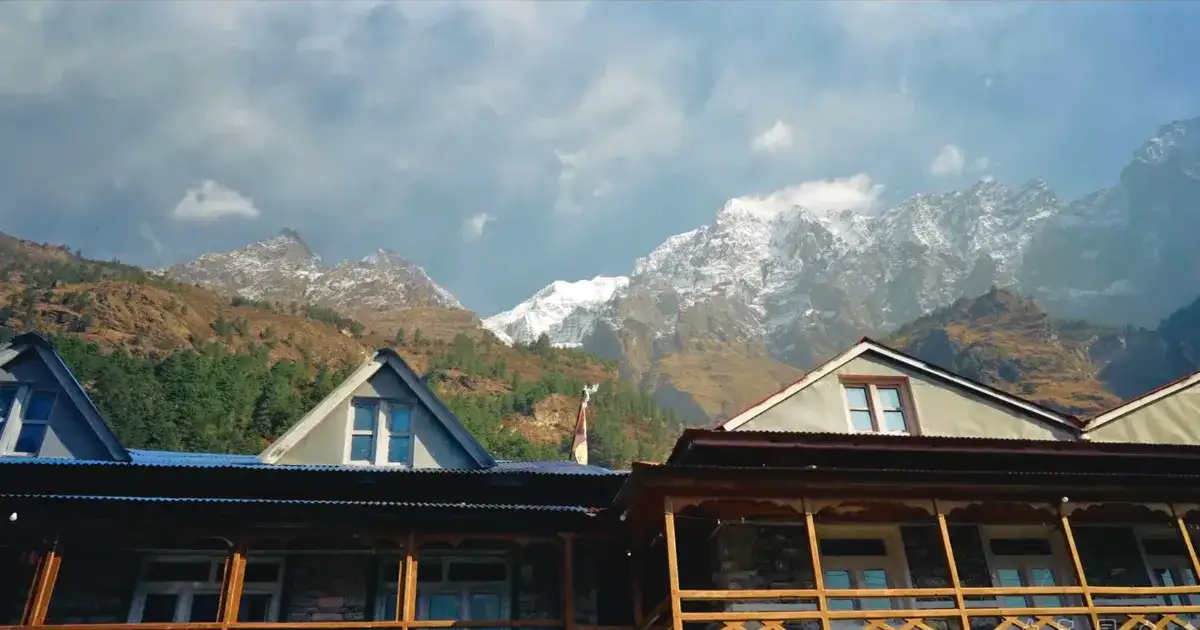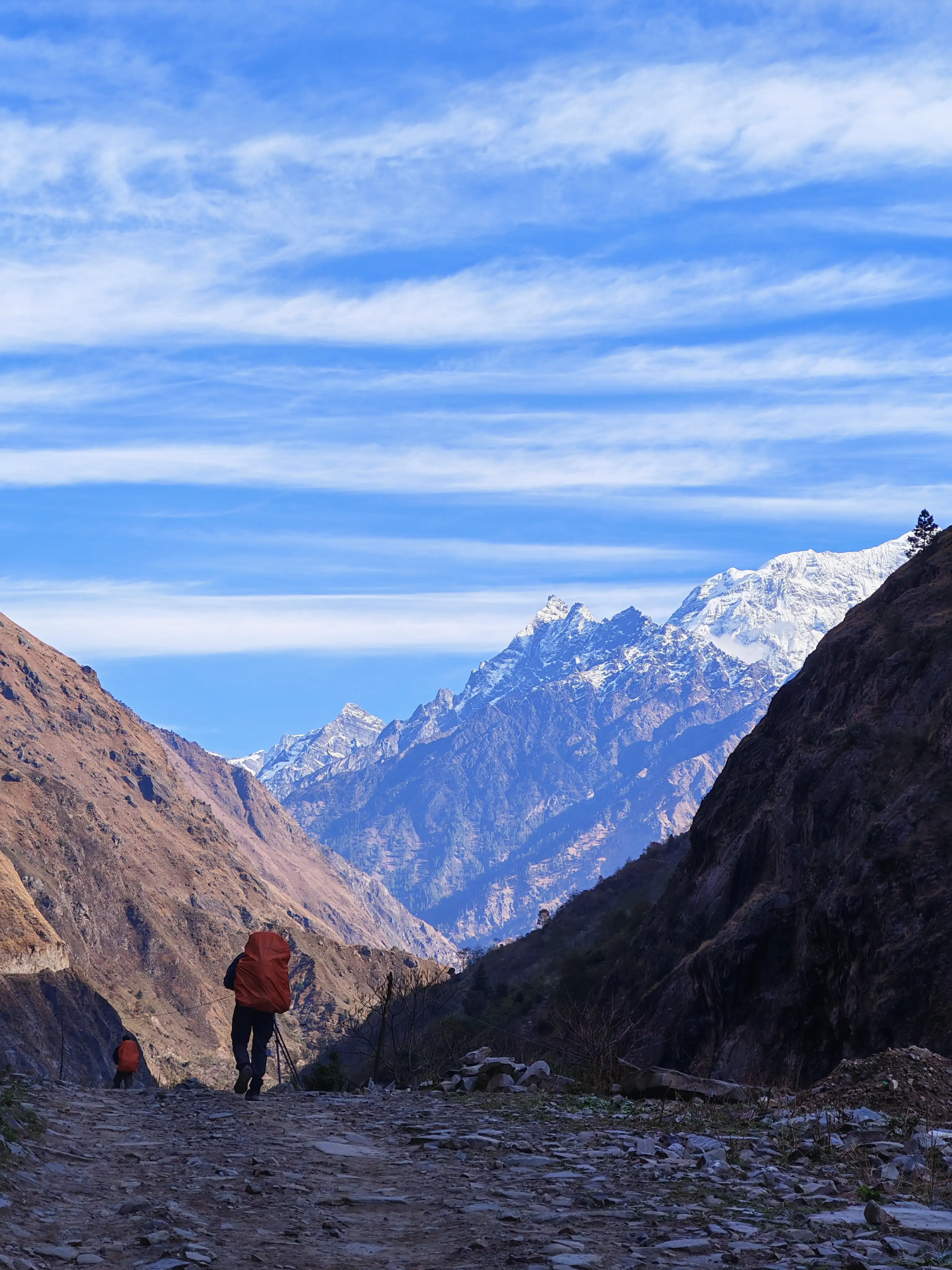
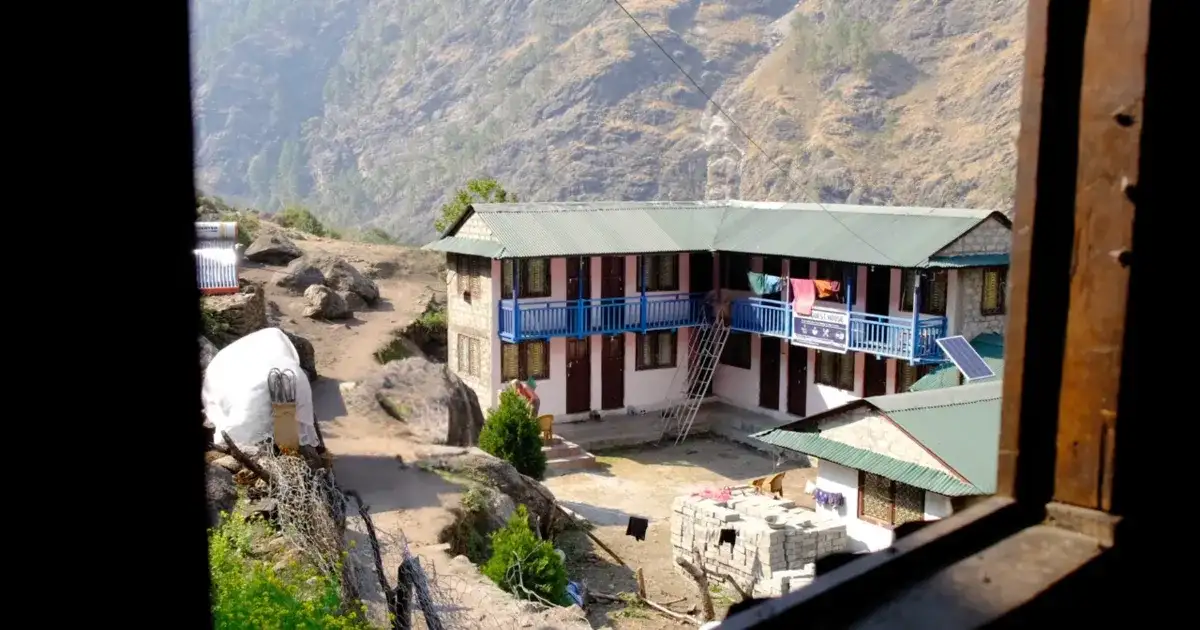
Morning in Jagat begins differently from a busy trekking hub. There are no crowded streets, no line of souvenir shops, and no constant movement of trekkers heading toward a famous viewpoint. Instead, there are stone-paved paths, terraced hillsides, prayer flags moving gently in the breeze, and the sound of the Budhi Gandaki River cutting through the valley below.
After breakfast, you shoulder your backpack and leave Jagat behind.
The first part of the trail feels relatively gentle. You pass through small settlements and farmland before the landscape begins to change. The trail rises and falls through forests, crosses suspension bridges, and follows the dramatic river valley toward Philim.
At Philim, the journey begins to feel noticeably different.
The village is larger than many settlements you have passed earlier, but beyond it the valley becomes quieter. Forests become denser, cliffs close in around the trail, and the number of trekkers begins to thin. Eventually, the trail reaches a junction where the route toward the Manaslu Circuit continues in one direction while the path toward Lokpa and the Tsum Valley branches away.
You take the Tsum Valley route.

The final section climbs through forest and rugged terrain before Lokpa gradually appears ahead. At around 2,240 meters, this small Himalayan settlement is more than just today's overnight stop. It is the traditional gateway to the remote Tsum Valley.
From here, the character of the trek changes again.
The villages become more strongly influenced by Tibetan Buddhist culture. The valley becomes more secluded, and the journey leads deeper toward Chumling, Chhekampar, Nile and the monasteries of upper Tsum.
That is what makes the trek from Jagat to Lokpa special. It is the transition between the lower Budhi Gandaki valley and one of Nepal's most culturally distinctive Himalayan valleys.
How long does it take to trek from Jagat to Lokpa?
The trek from Jagat to Lokpa takes approximately 6–7 hours, covering roughly 16–17 km, depending on the trail alignment and walking pace. Starting from Jagat at around 1,340 meters, the trail passes through Salleri, Sirdibas, Ghatte Khola, Philim, and Ekle Bhatti before turning toward Lokpa. This village is the gateway to the Tsum Valley, at approximately 2,240 meters. The route combines stone paths, suspension bridges, forested sections, steep climbs, and spectacular Himalayan scenery.
Where Is Lokpa?
Lokpa is a small settlement in Chumnubri Rural Municipality of Gorkha District, in the Tsum region of Nepal.
It sits at the entrance to the Tsum Valley and is surrounded by forests, steep Himalayan slopes, and dramatic mountain scenery. For those approaching from Jagat and Philim, Lokpa represents the point where the journey begins to move deeper into the Tsum Valley.
The settlement is relatively small and has far fewer accommodation and food options than popular trekking villages. This limited infrastructure is part of its appeal, but it also means you should not expect extensive facilities.
Lokpa is generally used as an overnight stop before continuing toward Chumling and the upper Tsum Valley.
Jagat to Lokpa Altitude Gain

Jagat sits at approximately 1,340 meters, while Lokpa is around 2,240 meters. That gives the day a net elevation gain of roughly 900 meters.
However, the actual amount of climbing your legs experience is greater than the simple difference between the 2 villages because the trail repeatedly descends and climbs again.
The elevation is not yet extreme by Himalayan trekking standards, but the increase is significant enough that pacing matters.
You may notice that the air feels cooler and the walking becomes more demanding as you approach Lokpa, especially if you are carrying a heavy backpack.
The good news is that this section is still relatively low compared with the upper Tsum Valley. The major altitude concerns of the trek come later as you climb toward Chhekampar, Nile and Mu Gompa.
Jagat to Lokpa Trekking Route
The route from Jagat to Lokpa passes through a fascinating combination of villages, river valleys, farmland, and forests.
Jagat to Salleri
Leaving Jagat, the trail initially follows a relatively manageable section through cultivated land and forest.
Salleri is one of the first settlements you encounter.
The landscape around here is still relatively green, with terraced fields and vegetation characteristic of the lower Manaslu region. Depending on the season, you may see villagers working in the fields or carrying supplies along the trail.
This section is a good warm-up before the more demanding parts of the day.
Salleri to Sirdibas
From Salleri, the trail continues toward Sirdibas. This is a traditional settlement in the Budhi Gandaki valley.
The trail alternates between relatively easy stretches and sections of climbing and descending.
Sirdibas is a useful place to pause, refill water, and take a short break before continuing toward Ghatte Khola.
The landscape also begins to show stronger signs of the region's Buddhist cultural influence, with mani walls, prayer flags, and traditional mountain architecture appearing along the route.
Sirdibas to Ghatte Khola
Beyond Sirdibas, the trail continues through the valley toward Ghatte Khola.
This section includes river crossings and suspension bridges. The Budhi Gandaki and its tributaries have shaped the dramatic terrain here, forcing the trail to climb, descend, and traverse the sides of steep valleys.
The bridges are among the memorable features of the lower Manaslu trail.
Take your time while crossing them, particularly if the weather is wet or the bridge is busy with porters, livestock, or other trekkers.
Ghatte Khola to Philim
After crossing the river, the trail climbs toward Philim, one of the more significant settlements along this section of the Manaslu route.
Philim is traditionally associated with the Gurung community and has more services than the smaller settlements along the trail.
Philim also offers an excellent opportunity to slow down and appreciate the landscape before heading into the quieter trail toward Lokpa.
Philim to Ekle Bhatti
Leaving Philim, the trail continues through forested terrain and narrower sections of the valley.
You eventually reach the area around Ekle Bhatti, a familiar stopping point on the Manaslu–Tsum Valley route.
It is also one of the most practical places for a lunch break.
A warm plate of dal bhat, noodles, or soup can make a noticeable difference before tackling the second half of the journey.
The sound of the river, waterfalls, and birds often replaces the sounds of villages. Forests surround much of the trail, and the mountains appear through gaps in the vegetation.
This is one of the sections where the trek begins to feel genuinely remote.
Ekle Bhatti to the Tsum Valley Junction (Gampul)
After Ekle Bhatti, the trail continues toward the point where the trekking routes separate.
One direction continues toward the main Manaslu Circuit and eventually toward Larkya La. The other heads toward Lokpa and the Tsum Valley.
If Lokpa is your destination, this is the turn you need to follow. The Tsum Valley route takes you into a quieter, more forested landscape. The trail crosses rugged terrain and gradually climbs toward Lokpa on the right side.
Final Climb to Lokpa
The last section of the day can feel demanding after several hours of walking. The trail climbs through forest before reaching Lokpa, which sits above the surrounding river valley.
After spending much of the day beside rivers and through narrow gorges, arriving at Lokpa feels like entering a different world.
The settlement is quiet, surrounded by forest and mountains, and offers a peaceful place to rest before the next day's trek toward Chumling.
What is the trail like from Jagat to Lokpa?
The trail is varied rather than consistently uphill.
Expect:
- Stone-paved sections
- Rocky and uneven paths
- Forest trails
- Terraced farmland
- Suspension bridges
- Steep uphill sections
- Short descents
- Narrow valley sections
- Waterfalls and streams
One of the biggest mistakes is assuming that a 16–17 km day will be easy because the altitude remains below 2,500 meters.
The repeated ups and downs can be tiring, especially with a backpack.
During dry seasons, dust can be an issue on sections affected by road construction. During the monsoon, slippery rocks, muddy trails, landslides, and swollen streams can make the same route considerably more difficult.
Is the Jagat to Lokpa Trek Difficult?
The trek from Jagat to Lokpa is generally moderate to challenging.
It is not a technical trek, and you do not need climbing equipment. However, you should be comfortable walking for 6 or 7 hours over uneven Himalayan terrain.
The main challenges are
Elevation gain: You gain around 900 meters between Jagat and Lokpa.
Long walking day: Six to seven hours is manageable for experienced trekkers but can be tiring for beginners.
Repeated climbs: The route does not simply climb steadily. You gain and lose elevation throughout the day.
Trail conditions: Rocky, muddy, or slippery sections can occur depending on weather.
Suspension bridges: Several crossings require concentration, particularly for those who are uncomfortable with heights.
With reasonable preparation and a comfortable pace, most physically fit trekkers can complete this section without major difficulty.
Permits Required for Trekking from Jagat to Lokpa
This is one of the most important parts of planning the route.
The permit requirements depend on whether you are simply traveling through the Manaslu side or continuing into the Tsum Valley.
Because Lokpa lies within the designated Gorkha Tsum Valley area, those heading from Jagat to Lokpa as part of a Tsum Valley trek need the appropriate restricted-area documentation.
Tsum Valley Restricted Area Permit
If you are continuing from the Jagat/Philim side to Lokpa and into the Tsum Valley, you also need the Tsum Valley Restricted Area Permit.
The current 2026 rates are
- September–November: USD 40 per person for the first 7 days
- Additional days: USD 7 per person per day
- December–August: USD 30 per person for the first 7 days
- Additional days: USD 7 per person per day
Manaslu Conservation Area Permit
The Manaslu Conservation Area Permit (MCAP) is also required.
For foreign nationals, the current fee is NPR 3,000 per person. SAARC nationals pay NPR 1,000, according to current Nepal Tourism Board/NTNC information. The MCAP supports entry and conservation management within the Manaslu Conservation Area.
Local Area Permit
The Nepal Tourism Board currently lists the Manaslu Circuit Trek, Manaslu–Tsum Valley Trek and Tsum Valley Trek among the routes where a local area permit and licensed trekking guide are required.
The current TIMS fee is NPR 1,000 for SAARC and non-SAARC trekkers. Your registered trekking agency will arrange all permits together with the rest of your trekking documentation.
Do You Need ACAP for Jagat to Lokpa?
No. The Annapurna Conservation Area Permit (ACAP) is not required simply for trekking from Jagat to Lokpa.
ACAP becomes relevant if your wider itinerary crosses into the Annapurna Conservation Area, such as a Manaslu Circuit itinerary continuing beyond Larkya La toward Dharapani.
For a Tsum Valley trek that returns through the Manaslu side, ACAP is generally not part of this section.
Can You Trek from Jagat to Lokpa Without a Guide?
No. The Manaslu and Tsum Valley routes are restricted trekking areas. However, there is an important 2026 update that many older travel blogs have not incorporated.
On March 22, 2026, Nepal's Department of Immigration removed the previous minimum 2 person requirement for restricted-area permits. This means a foreign traveler can now obtain a restricted-area permit as a solo trekker. But this does not mean completely independent trekking is permitted.
A licensed trekking guide remains mandatory, and the trek must be arranged through a registered trekking agency.
In practical terms, you can now do a private trek with just yourself and your guide rather than having to find another trekker to meet the old minimum group requirement.
Where to Stay in Lokpa?
Accommodation in Lokpa is basic compared with popular trekking destinations in Nepal. You should expect small teahouses or mountain lodges rather than hotels or luxury lodges.
Facilities generally include:
- Basic private or twin-sharing rooms
- Shared toilet facilities
- Dining area
- Simple local meals
- Hot tea and other drinks
- Limited charging facilities
- Basic hot-water facilities, depending on the lodge
The number of lodges is limited, so accommodation can become scarce during the peak trekking seasons. For autumn and spring, it is sensible to have your guide contact the lodge in advance, particularly if you are traveling with a group.
Do not expect the same accommodation choice you would find in other big cities. That simplicity is part of the appeal of Lokpa.
Food on the Jagat to Lokpa Trail
You can find basic meals at villages and teahouses along the route, although the selection becomes more limited as you move farther from the larger settlements.
Common trekking meals include:
- Dal bhat
- Vegetable curry
- Fried rice
- Noodles
- Pasta
- Soup
- Tibetan bread
- Eggs
- Potatoes
- Porridge
- Tea and coffee
Dal bhat remains one of the best choices for a long trekking day because it provides carbohydrates, vegetables, and protein and can usually be refilled at teahouses.
Ekle Bhatti is a convenient place for lunch.
However, if you have dietary restrictions, bring some additional snacks because food choices become more limited as you move deeper toward Lokpa and the Tsum Valley.
Drinking Water on the Trail
Water is available at settlements, teahouses, and natural sources along the route, but trekkers should not assume that clear-looking Himalayan water is automatically safe to drink.
Carry a reusable bottle or hydration bladder and treat water using one of the following:
- Water filter
- Purification tablets
- UV purifier
- Boiled water from teahouses
Avoid unnecessary single-use plastic bottles, particularly in remote areas where waste management is limited.
A good target is to carry enough water between reliable refill points rather than carrying several liters unnecessarily throughout the entire day.
Internet and Mobile Connectivity
Connectivity on the Jagat to Lokpa trail is limited and unreliable.
You may find mobile coverage around some villages, but there can be long stretches without a stable signal.
Internet access in teahouses is also much less reliable than in major trekking centers.
If you need to stay connected for work or emergencies, do not plan your trek around continuous internet access. The better approach is to download maps, important documents, and offline information before leaving Kathmandu.
Your guide should also know the local communication and emergency arrangements.
Electricity and Charging
Electricity is available in some lodges, but charging facilities can be limited.
Bring:
- Power bank
- Charging cable
- Spare batteries for cameras
- Universal adapter
- Headlamp
Charging may involve an additional fee at teahouses.
If photography is an important part of your trek, carrying a high-capacity power bank is particularly useful.
Best Time to Trek from Jagat to Lokpa
The best seasons are generally spring and autumn.
Loka in Spring: March to May
Spring brings warmer conditions, clearer mountain views, and blooming rhododendrons in parts of the lower trail.
March can still be cool, while April and May gradually become warmer.
This is an excellent season for photographers because forests and mountain landscapes can be particularly colorful.
Lokpa in Autumn: September to November
Autumn is usually the most popular trekking season.
The monsoon has cleared the atmosphere, mountain views are often excellent, and daytime trekking conditions are generally comfortable.
October is particularly popular. The downside is that accommodation and transport can be busier than during the quieter months.
Lokpa in Winter: December to February
Winter trekking is possible at lower elevations such as Jagat and Lokpa. But the temperatures can become cold, especially at night.
Snow becomes a more important consideration as you continue deeper into the Tsum Valley and toward higher elevations.
If trekking in winter, bring adequate insulation and check current trail conditions with your trekking agency.
Lokpa in Monsoon: June to August
The monsoon is generally the least favorable period. Rain can make trails slippery and increase the risk of landslides and swollen streams. Clouds can also obscure mountain views.
If you plan to trek during the monsoon, allow flexibility in your itinerary and rely on local trail information. It will be a bit riskier to assume that conditions will match a dry-season itinerary.
What to Pack for Jagat to Lokpa
Because the route remains relatively low compared with the upper Tsum Valley, you do not need an extreme high-altitude expedition kit for this single day.
However, you should prepare for changing weather.
Essential items include:
- Comfortable trekking boots
- Trekking poles
- Lightweight rain jacket
- Waterproof backpack cover
- Warm fleece
- Lightweight down jacket
- Trekking trousers
- Quick-drying shirts
- Sun hat
- Sunglasses
- Sunscreen
- Reusable water bottle
- Water purification method
- Headlamp
- Power bank
- Basic first-aid kit
- Personal medications
- Energy snacks
- Passport and permit copies
- Sleeping bag, especially during colder seasons
Note: If you are continuing into the upper Tsum Valley, pack for significantly colder conditions than those you experience around Jagat and Lokpa.
Safety Tips for the Jagat to Lokpa Trek
Although this is not a technical route, the terrain deserves respect.
Start early so you have plenty of daylight. Keep your trekking pace steady rather than trying to finish quickly.
Give way to mule and livestock trains on narrow sections. Be especially careful on suspension bridges and wet rocks.
During or after heavy rainfall, ask your guide about landslide-prone sections before leaving. Carry sufficient drinking water and snacks.
Keep your passport and trekking permits readily accessible, as checkpoints may require verification.
Most importantly, follow the designated trail. The Nepal Tourism Board advises trekkers to remain on designated routes and carry the required trekking documentation.
Trekking with a Guide and Porter
A licensed guide is mandatory for the Manaslu/Tsum Valley restricted route. A guide adds more than regulatory compliance.
A good local guide can help you:
- Navigate trail junctions
- Arrange accommodation
- Communicate with teahouse owners
- Explain local culture
- Monitor changing weather
- Identify safer water sources
- Handle permit checkpoints
- Coordinate emergency assistance
- Adjust the itinerary when trail conditions change
A porter is optional but can make the trek substantially more comfortable.
What Makes the Jagat to Lokpa Trek Special?
The best part of this route is not one single viewpoint. It is the gradual change in the landscape. You begin among terraced fields and lower Himalayan vegetation around Jagat.
Then you move through Gurung settlements, cross suspension bridges, and pass through the Budhi Gandaki valley.
After Philim, the trail becomes quieter. The forests become deeper. The valley becomes narrower.
And finally, you reach Lokpa, the gateway to the Tsum Valley.
From here, the landscape and culture continue to change as you move toward Chumling and the higher settlements.
For those who enjoy experiencing a region rather than simply collecting famous viewpoints, this transition is one of the most rewarding parts of the Manaslu–Tsum Valley journey.
What to See Between Jagat and Lokpa
Keep an eye out for:
- Traditional Gurung settlements
- Stone houses
- Terraced farmland
- Mani walls
- Prayer flags
- Suspension bridges
- Waterfalls
- Budhi Gandaki River
- Dense pine and mixed forests
- Dramatic river gorges
- Himalayan mountain views
- Traditional village life
The trail is particularly rewarding for photographers because the landscape changes dramatically over a single day.
Jagat to Lokpa vs Jagat to Deng
These two routes are sometimes confused because both begin from Jagat and form part of wider Manaslu trekking itineraries.
The difference is simple:
Jagat to Deng continues along the main Manaslu Circuit toward Namrung and Samagaun.
Jagat to Lokpa branches toward the Tsum Valley and is normally part of a Tsum Valley Trek or Manaslu–Tsum Valley combined trek.
If your itinerary includes Lokpa, Chumling and Chhekampar, you are entering the Tsum Valley rather than simply following the standard Manaslu Circuit.
Frequently Asked Questions About Trekking from Jagat to Lokpa
Is Jagat to Lokpa difficult?
The trek is moderate to challenging because of the 16–17 km distance, approximately 900 meters of net elevation gain, repeated climbs and descents, suspension bridges and uneven terrain.
Is there internet in Lokpa?
Connectivity is limited and can be unreliable. Do not expect continuous mobile data or Wi-Fi.
Are there ATMs between Jagat and Lokpa?
No. There are no reliable ATM facilities along this remote trekking section. It is best to withdraw sufficient Nepalese rupees in Kathmandu or another major town before starting the trek. Keep some cash available for personal expenses, drinks, snacks, charging, and other services.
How much cash should I carry for this part of the trek?
There is no fixed amount because most organized trekking packages cover accommodation and meals. However, carrying approximately NPR 3,500 per person per day for personal expenses is enough for food and drinks. For a longer trek, carry enough cash for the entire remote section rather than relying on electronic payments.
Are there toilets along the Jagat to Lokpa trail?
Basic toilet facilities are available at teahouses and settlements, but you should not expect Western-style toilets throughout the route. Some trail sections have no toilet facilities at all, so using the facilities at your accommodation or lunch stop before entering longer remote sections is advisable.
Can I take a hot shower in Lokpa?
Hot showers are not guaranteed in Lokpa. Facilities in remote teahouses are basic, and availability depends on the lodge and season. If shower facilities are available, they may cost extra. Wet wipes and a small personal towel are useful alternatives in this section.
Is the Jagat to Lokpa trail suitable for photography?
Yes. The route offers excellent opportunities for landscape and cultural photography. Look for traditional villages, suspension bridges, waterfalls, forests, terraced fields, prayer flags, and dramatic river gorges. The changing landscape also gives photographers a good variety of subjects within a single trekking day.
Can I use a drone between Jagat and Lokpa?
Do not assume that you can freely fly a drone simply because the landscape is remote. Drone use in Nepal is subject to aviation and location-specific restrictions, and protected or restricted areas can involve additional considerations. If aerial photography is important to your trip, arrange the necessary permissions through your trekking agency before departure.
Is there a medical post between Jagat and Lokpa?
Medical facilities are limited in this remote section. Do not rely on finding a fully equipped clinic along the trail. Carry essential personal medication and a basic first-aid kit, and inform your guide about any relevant medical needs before starting the day's walk.
Where can I leave luggage that I don't need on the trail?
If you are returning to Kathmandu after your trek, ask your hotel or trekking agency whether they can store non-essential luggage. Many travelers leave city clothes and other unnecessary items in Kathmandu and take only their trekking equipment into the mountains.
Are there any animals or livestock on the Jagat to Lokpa trail?
Yes. You may encounter pack animals and livestock using the same trail. When meeting animals on narrow sections, follow your guide's instructions and move to a safe side of the trail. Avoid standing on the outside edge of a narrow path when a loaded animal is passing.
Can children trek from Jagat to Lokpa?
It depends on the child's age, previous trekking experience, fitness, and ability to handle a long mountain walking day. Families should also consider the limited medical infrastructure and basic accommodation. A customized itinerary with shorter walking days may be more appropriate than simply following a standard adult trekking schedule.
Is Lokpa a good place to spend an extra rest day?
Usually, it is more practical to continue toward Chumling rather than schedule a dedicated acclimatization day at Lokpa, unless your guide recommends otherwise. The better location for acclimatization depends on your overall itinerary and the elevation you plan to reach afterward.
Is the Jagat to Lokpa route culturally sensitive?
Yes. You are traveling through communities where Buddhist traditions and local customs are part of everyday life. Ask before photographing people, monasteries, or private property, and follow your guide's instructions around religious structures. The best approach is to treat villages as living communities rather than tourist attractions.
Can I do the Jagat to Lokpa trek as part of a photography trek?
Absolutely. In fact, this is one of the more interesting sections for photography because the scenery changes from lower elevation. The scenery shift from villages and farmland to dense forests, dramatic gorges, and the entrance to the Tsum Valley. A photography-focused itinerary should allow extra time at viewpoints rather than treating the route purely as a point-to-point walking day.
Final Thoughts
The trek from Jagat to Lokpa is one of those Himalayan walking days that becomes more rewarding the farther you go.
You leave the stone streets of Jagat and gradually move through terraced hillsides, Gurung settlements, river crossings, and dense forests. Philim provides a natural midpoint, but beyond it the trail becomes quieter and more remote.
Then comes the turn toward Tsum Valley.
By the time you reach Lokpa, the landscape has already begun to change. The valley feels more secluded, the forests close around the trail, and the cultural character of the journey becomes increasingly Tibetan Buddhist.
Lokpa is therefore more than an overnight stop.
It is the gateway to the Tsum Valley and the beginning of a deeper Himalayan experience.
If you are planning a Manaslu Circuit with a Tsum Valley extension, give this section the time it deserves. Walk slowly, look beyond the trail, talk to local people when appropriate, and pay attention to the small details.
The mountains are impressive.
But on the trail from Jagat to Lokpa, it is the gradual transition between landscapes, communities, and cultures that makes the journey memorable.